

There is a quiet shift happening in climate risk analysis. For years, the focus was on getting organisations to recognise that physical climate risk exists. That battle has largely been won. Today, banks, insurers, asset managers and governments - even home buyers - all acknowledge that climate risk matters. But a new problem appears to be emerging: disclosure is replacing understanding and action.
Across markets, climate risk analysis is increasingly shaped by evolving reporting frameworks and expectations. While these have driven progress, they have also created unintended consequences. One way to see this is in who owns the work: it began with sustainability teams, shifted to risk teams, and is now moving toward finance - largely because finance handles compliance. That final shift, while practical, is a step backwards. Climate change is fundamentally a RISK, and it should remain anchored within risk functions. A compliant disclosure may satisfy requirements, but it does not reduce or remove the underlying risk.
Companies are “marking their own homework”
Much of climate risk reporting remains self-reported. Even now, only around one-third of companies have adaptation plans (S&P Global data via World Economic Forum), and fewer still link those plans to capital allocation, assets, and operations (Transition Pathway Initiative, 2025). In other words, climate risk is being disclosed, but not consistently understood, and often not acted upon. When only a small proportion of suppliers and buyers have adaptation plans, supply chain exposure to climate impacts is not the exception, it is the baseline.
We don’t have comparability, we have excuses
A common challenge in climate risk reporting is that different methodologies produce different results, making “apples-to-apples” comparisons difficult - particularly given the range of vendor approaches. The same asset can be assessed very differently depending on the model used. This should not be seen solely as a weakness. Different models can offer different perspectives and insights, allowing for triangulation and a more robust understanding of risk. However, in practice, this variability is often used as a reason to delay action. Decision-makers point to a lack of standardisation or imperfect data as justification for inaction - an argument that will be familiar to anyone who has worked in climate policy. In reality, uncertainty does not negate risk. Where there is clear exposure (such as a commercial asset in a flood-prone area) the direction of travel is evident, and the risk is increasing.
Yes, we know we’re under-estimating, but the next generation of indirect impact models is here
Current reporting focuses on direct asset risks, and those models are improving. But they only capture part of the picture, and often the more manageable part. The real impacts are frequently indirect: infrastructure failures, supply chain disruption, and regional shocks. In many cases, these second-order risks exceed direct losses. A factory is far more likely to fail due to loss of power, water or access than physical damage alone. What has been missing is now emerging: models that capture these indirect, system-wide impacts are here and changing the baseline for analysis.
Physical risk is… physical
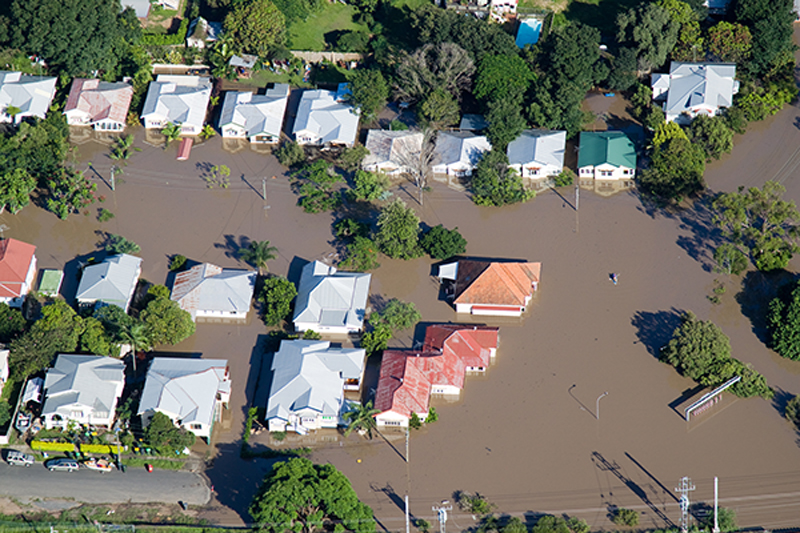
Climate risk manifests in real-world failures: flooded infrastructure, damaged assets, and disrupted systems. If adaptation plans are not translated into tangible, pre-emptive actions or do not clearly show how impacts will be managed or transferred, they have limited value for stakeholders seeking to assess and compare corporate risk. This need not be onerous. At last year’s London Climate Action Week, we set out a practical approach in our paper, Measuring Corporate Resilience, showing how simple, machine-readable adaptation disclosures could enable AI and third parties to incorporate these plans directly into risk analysis.
The limits of compliance-driven thinking
Compliance has driven progress, but it often results in simplified analysis that does not support real decisions. Assessing physical climate risk is not just a reporting exercise, it is a core decision-making tool for boards, investors, and infrastructure operators. It is also meant to inform practical judgements: Do I trust this company as a supplier? As an investment? As a custodian of critical assets or data?
This is not theoretical. Our analysis of global data centres (2025 Global Data Centre Physical Climate Risk and Adaptation Report), found that some companies had more than 20% of their assets classified as high risk. Reporting must therefore be capable of answering these questions. If it does not, stakeholders will look elsewhere, pushing analysis “underground” and eroding trust. The result is climate risk reporting that is produced, but neither read nor believed.
Moving from disclosure to understanding to action
So what are some better approaches to increase understanding of risk and drive the implementation of concrete resilience measures?
We can:
- Focus on asset-level exposure - giving crucial first-step insights into how and at what points an asset could be made more resilient (asset-level adaptation)
- Incorporate system interactions (cross dependency analysis) - assessing how the systems an asset is reliant on could be impacted by climate hazards can pinpoint weak points where system upgrades, adaptation measures or relocation could be implemented
- Demonstrate adaptation planning - instead of simply providing compliance checkboxes, physical climate risk insights should translate into clear, actionable opportunities to improve the resilience of assets and infrastructure, as well as consequence management (adaptation cost-benefit analysis and exploration of multiple pathways).
A race to resilience
Physical climate risk analysis need not be reduced to a reporting competition, it can be a race to reduce real-world risk and real-world impacts. The conversation is fast evolving, but ultimately we must strive to ensure that companies have all of the information they need to navigate all stages of becoming more resilient:
1. Awareness of physical climate risk
2. A comprehensive understanding of system-wide physical climate risk impacts
3. Disclosure of physical climate risk
4. Meaningful adaptation plans
5. Resilience (The final goal)
Conclusion
Compliance is only part of the journey. Addressing climate physical risks isn't just a box-ticking exercise, it requires plans and action. The real audience for climate reporting is not regulators, it's actually the investors, counterparties and customers, and all of them want to see a pathway to resilience.
Related posts

XDI launches Automated Resilience in the XDI Climate Risk Hub. Here's why it matters.
From Australian homes to commercial assets: the adaptation challenge
The Missing Metric: Why measuring climate risk is no longer enough

Measuring resilience requires more than one perspective
Contact us
Get in touch with one of our friendly team


Help & Support
Support and help for our customers
Get support
Complete the form so we can connect you to the right specialist to support your distinct needs.


Media & Press
Fill in the form to get in touch with our media team
Contact our media team
We have an experienced communication and media team that can assist with media enquiries.